
Building for a greener future
Planning for sustainable development
How we design, build, and improve our homes and buildings plays a major role in reducing emissions, lowering energy bills, and creating healthier places to live.
Through planning, guidance and investment, the Council are working to reduce the environmental impact of buildings across West Oxfordshire. This includes lowering lifetime carbon emissions, improving energy efficiency, and supporting residents to access affordable retrofit options.
New developments are also expected to be climate-ready, with innovation encouraged in sustainable design and construction.
Creating places that are comfortable now and ready for the future
The Council supports the delivery of energy-efficient, low-carbon homes by promoting tools such as the Net Zero Carbon Toolkit. This helps developers and designers to create buildings that minimise energy demand, integrate renewable energy systems, and use low-carbon materials.
The aim is to ensure that sustainable design is both practical and cost-effective, enabling high-quality development that aligns with net zero ambitions.
Planning policies play a key role in shaping development that supports a net-zero and climate-resilient future. New developments are expected to incorporate energy-efficient design, support biodiversity and include green infrastructure.
They must also address flood risk through sustainable drainage, prioritise walking, cycling and public transport, and ensure buildings are designed to adapt to future climate conditions.
Biodiversity and nature in development
Protecting and enhancing biodiversity is central to sustainable growth, Biodiversity Net Gain (BNG). is a national requirement for new large-scale developmenrs, requiring habitats to be left in a measurably better condition than before development took place. This can be achieved through on-site habitat creation and enhancement, or through off-site biodiversity improvements where appropriate
This includes the creation and enhancement of green spaces, tree planting and habitat restoration, alongside the integration of green infrastructure within developments. These features support wildlife while also contributing to climate resilience, improving air quality and creating healthier places to live.
The Council works closely with developers to ensure biodiversity is considered from the earliest design stages, helping to deliver high-quality, nature-positive development across West Oxfordshire, and aligning with Oxfordshire’s Local Nature Recovery Strategy.
Sustainability Standards Checklist
All planning applications are encouraged to use our checklist, covering:
- Water use and flood risk
- Biodiversity
- Active and low-carbon travel
- Net-zero alignment
- Sustainable construction
- Climate adaptation
This helps developers design more sustainable schemes and allows the Council to assess environmental impact consistently.
Download Sustainability Standards Checklist
Leading by example: Salt Cross Garden Village
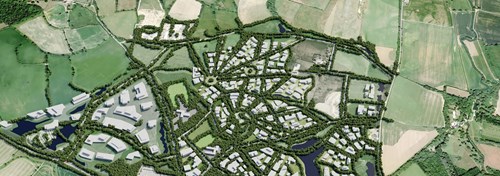
Salt Cross Garden Village demonstrates how these principles can be applied in practice. The development is designed to deliver net zero carbon homes and buildings, supported by walkable neighbourhoods, and strong cycling and public transport links.
It also integrates green infrastructure and biodiversity throughout the site, alongside sustainable drainage and energy-efficient design, setting a benchmark for future development across the district.